If you are reliably hungry ninety minutes after breakfast, and reliably flattened by mid-afternoon, the problem is more likely to be the composition of your first meal than your willpower. Breakfast sets a metabolic tone, and a pastry sets a very different one from a plate of eggs.
Key takeaways
- Refined carbohydrates eaten alone produce a faster rise and fall in blood glucose than the same carbohydrates eaten with protein, fat or fibre.
- The subsequent dip is what most people experience as the mid-morning slump and the 3pm crash.
- Protein and fibre at breakfast improve satiety and reduce the size of the glucose response.
- A practical target for most adults is roughly 25–30g of protein at breakfast.
- Anyone with diagnosed diabetes or prediabetes should change their diet in consultation with their clinical team.
What actually happens after a pastry
Refined flour and sugar are digested quickly. Eaten on their own, they arrive in the bloodstream as glucose faster than the body needs it, and the pancreas responds with insulin to move it into cells. That system works well. The issue is the shape of the curve.
A sharp rise tends to be followed by a sharp fall, and the low end of that fall is where the symptoms live: hunger, difficulty concentrating, irritability, a craving for something sweet. Which produces another quick-digesting snack, and another curve.
Adding protein, fat or fibre to the same meal slows gastric emptying and flattens the curve. The total energy can be identical; the experience of the next three hours is not.
You are not lacking discipline at 11am. You are responding, entirely predictably, to what you ate at 8am.On the physiology of the mid-morning slump
Why a European breakfast is unusually low in protein
Croissant and coffee. Toast and jam. Cereal with milk. Fruit and a juice. These are culturally normal breakfasts and they have something in common: almost no protein.
Typical figures give some sense of the gap. A croissant is around 5g of protein. Two slices of toast with jam, roughly 6g. A bowl of cornflakes with milk, around 8g. Against a sensible breakfast target of 25–30g, these are a third of the way there at best — and this repeats every single morning.
It also matters for muscle. Because older adults need a larger dose of protein per meal to trigger the same muscle-building response, a chronically low-protein breakfast is a missed opportunity three hundred and sixty-five times a year.
Breakfasts that hold up
The principle is simple: build the meal around a protein source, then add fibre.
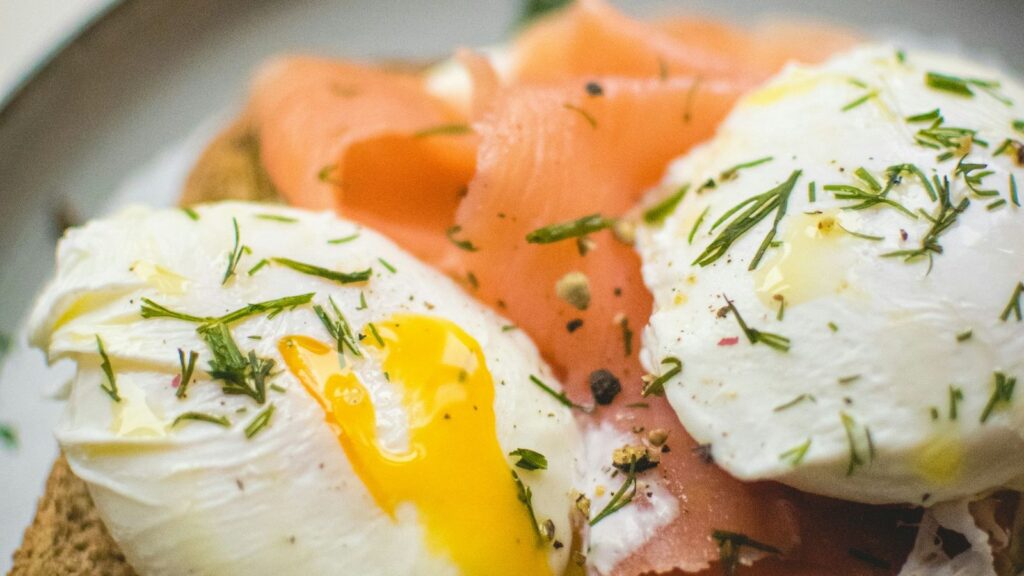
- Three eggs with wholegrain toast — roughly 22–25g of protein.
- Greek yoghurt (200g) with berries and nuts — roughly 20g, and high in fibre.
- Cottage cheese on rye with tomato — roughly 25g.
- Overnight oats made with milk plus a scoop of protein powder — 25g and up.
- A complete-meal shake — the most practical option if mornings are rushed or appetite is low.
You do not need to eliminate the croissant. You need to stop asking it to be the entire meal. A croissant alongside eggs behaves very differently from a croissant alone.
If you have diabetes or prediabetes, or you are taking glucose-lowering medication, do not change your eating pattern without speaking to your GP or diabetes team. Individual glucose responses vary considerably, and medication doses may need adjusting.
Give it a fortnight
This is one of the few dietary changes with a fast, self-evident read-out. Hold breakfast at 25–30g of protein for two weeks and pay attention to two things: whether you are hungry before lunch, and whether the afternoon dip still arrives on schedule. Most people notice a difference within a week, which makes the habit unusually easy to keep.
Sources and further reading
- Harvard T.H. Chan School of Public Health. The Nutrition Source. nutritionsource.hsph.harvard.edu/
- British Nutrition Foundation. Nutrition science and healthy eating resources. www.nutrition.org.uk/
- NHS. Live Well: eat well, exercise and sleep guidance. www.nhs.uk/live-well/
- Mayo Clinic. Healthy lifestyle: nutrition and fitness. www.mayoclinic.org/healthy-lifestyle
This article is general information and is not a substitute for advice from a qualified clinician.