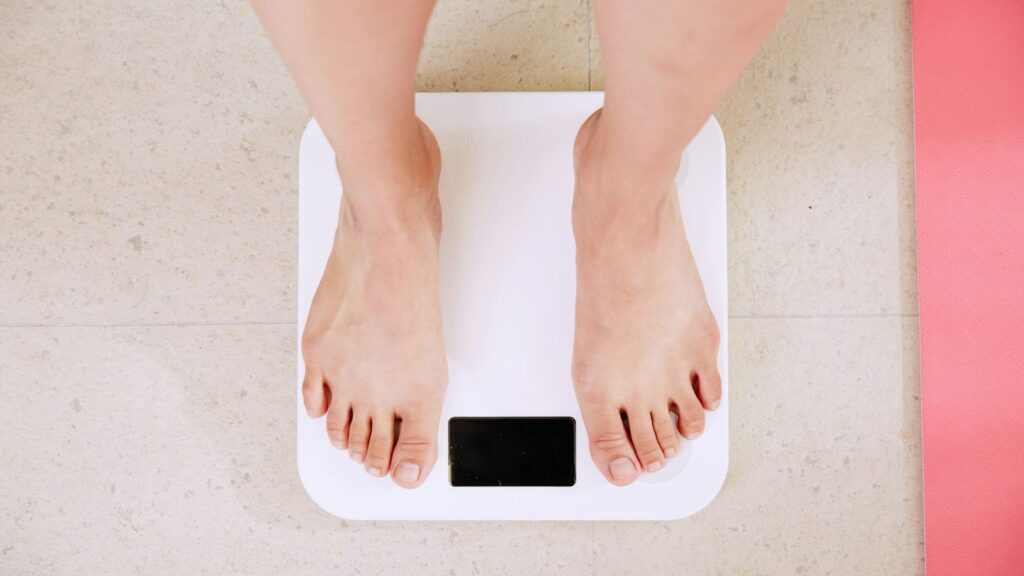
You did everything the same and the scale stopped moving. This is the most predictable event in weight loss and the most demoralising, largely because it is usually explained as a motivation problem when it is really an arithmetic one. Four things change as you lose weight, and together they close the gap you originally opened.
Key takeaways
- A smaller body burns fewer calories, so the deficit you started with shrinks as you lose weight.
- Non-exercise movement falls quietly during dieting — often without you noticing.
- Reported intake drifts upward over time in nearly all studies that measure it.
- Water retention can mask genuine fat loss for weeks at a time.
- Sustained plateaus alongside fatigue, hair loss or cold intolerance are worth a medical review.
Mechanism one: you are smaller now
A body of 80kg costs more to run than a body of 72kg. Less tissue to maintain, less mass to move, lower total energy expenditure. If you built a 500-calorie deficit at your starting weight and changed nothing since, that deficit is materially smaller now — and at some point it reaches zero.
This is not a malfunction. It is the expected consequence of the thing you set out to do.
A plateau is not your body refusing to cooperate. It is your body having successfully adapted to the instruction you gave it.On metabolic adaptation
Mechanism two: you are moving less than you think
Non-exercise activity thermogenesis — NEAT — covers everything that is not deliberate exercise: fidgeting, standing, walking around the house, gesturing. It is a substantial and highly variable part of daily expenditure, and it falls during energy restriction, largely unconsciously.
You take the lift more often. You sit rather than stand. You are marginally stiller in every hour of the day. Your training is unchanged, so the reduction is invisible — but the total can be considerable.
Mechanism three: portions drift
Every study that compares reported intake with measured intake finds under-reporting, and it grows over time. Not through dishonesty — through the ordinary erosion of precision. The oil stops being measured. The handful gets larger. The weekend becomes two days rather than one meal.
Two or three hundred calories a day of accumulated drift is enough to erase a moderate deficit entirely, and it is close to impossible to detect by feel.
Worth a doctor’s appointment if a plateau lasting more than eight weeks comes with unusual fatigue, feeling cold, hair thinning, constipation or low mood — the pattern can point to an underactive thyroid. Several common medications also affect weight.
Mechanism four: water is hiding the result
Fat loss and weight loss are not the same measurement. Glycogen binds water, muscle repair after unaccustomed training holds fluid, salt intake varies, and hormonal cycles shift several kilograms of water across a month. It is entirely possible to lose fat for three weeks while the scale reads flat, and then to drop 1.5kg in two days when the fluid clears.
This is why a single weigh-in is nearly useless and a seven-day rolling average is not.
What to actually do
- Measure the trend, not the day. Weigh daily, average weekly, and compare week to week.
- Re-audit intake for one week. Weigh everything. Expect to be surprised; that surprise is the useful part.
- Add steps before cutting calories. Restoring the NEAT you lost is easier and more sustainable than eating less again.
- Protect muscle. Keep resistance training and keep protein high, or the weight you lose will include the tissue that was keeping your metabolic rate up.
- Consider a deliberate pause. Several weeks at maintenance is a legitimate strategy, not a surrender.
Sources and further reading
- National Institute on Aging. Health topics: exercise, nutrition and healthy ageing. www.nia.nih.gov/health
- NHS. Live Well: eat well, exercise and sleep guidance. www.nhs.uk/live-well/
- Harvard T.H. Chan School of Public Health. The Nutrition Source. nutritionsource.hsph.harvard.edu/
- Mayo Clinic. Healthy lifestyle: nutrition and fitness. www.mayoclinic.org/healthy-lifestyle
This article is general information and is not a substitute for advice from a qualified clinician.